Keong Hong is a Singapore main contractor with property exposure and a non-controlled Maldives hotel and airport associate.
Latest figures
Its disclosed construction order book was S$217m; at 30 June 2026 cash and fixed deposits were S$28.235m, of which S$6.1m was pledged, against S$3.685m of borrowings, S$3.754m of leases and a S$12.750m shareholder loan.
Main risk
The central risk is that the audit qualification, guarantees and limited access to associate cash weaken the apparent group liquidity.
Next proof
The next test is order-book cash conversion and audited evidence resolving the qualification and associate funding gaps.
No public letter rating or valuation. Information cutoff: 28 August 2026. The latest issuer filing located in the announcement sweep was the 13 August 2026 9MFY2026 result and accompanying Rule 706A announcement. The listed-parent tape was checked through the cutoff; the PIIPL associate stream remains gapped, so this page does not claim complete group-wide filing coverage.
Evidence balance
The live questionCan certified construction progress and non-controlled associate assets convert into cash the listed parent can actually use?The nine months to June 2026 saw revenue fall 56.3% to S$68.548m while operations used cash, so whether the order book converts into collected parent cash now decides liquidity.
What improved
The third quarter alone was profitable: S$23.737m of revenue produced S$2.964m gross profit, a 12.5% margin and S$1.259m profit after tax, and the disclosed construction order book had risen to approximately S$217m at 30 June 2026 from approximately S$203m at 30 September 2025.
What became more demanding
Nine-month operations used S$7.646m of cash as payables and contract liabilities fell, and the disclosed liquidity bridge, after pledged deposits, bank borrowings, leases and the S$12.750m shareholder loan, leaves only S$1.946m of accessible economic net cash.
Strongest alternative explanation
The nine-month cash use could reflect a completing project cohort unwinding payables as activity falls after the 56.3% revenue decline rather than distress, and the 12.5% third-quarter margin would be consistent with better execution; neither by itself establishes that the order book converts to parent cash.
The decisive missing fact
The filings do not say what portion of the S$217m order book is executable, on what gross margin and cash schedule, nor PIIPL's debt service, distributable cash and any dividends or shareholder-loan repayments to Keong Hong.
Drawn from the evidence on this page: the improvement, the constraint, the benign reading and the fact that would settle it. It states no view on the shares.
About the private research record
Also on file for this company, behind the private view 🔒 (author-only): the full initiation note, detailed equity scenarios, the internal credit assessment, source and claim registers, and independent re-key and render checks. No compliant model workbook was produced because the required spreadsheet runtime was unavailable. These working materials remain private and are not for distribution.
On this page
Business anatomy · operations, customers and cash
Construction progress earns revenue; property distributions bring capital home
Singapore building contracts are the operating engine, while property and hospitality interests create a separate, less direct path to parent cash.
Read each card by investor role: business line, operating step, customer outcome or cash conversion.
Contract awardConstruction award
Win the project
What happensA public agency or private developer awards Keong Hong a building contract with scope, programme and milestones.
Commercial triggerThe contract adds work to the order book.
Company actionExecution
Procure, manage and build
What happensKeong Hong coordinates materials, labour and subcontractors to deliver the project and its defects obligations.
Value createdCertified construction progress creates revenue and a receivable.
Cash conversionConstruction cash
Turn certification into cash
What happensThe customer certifies completed work, receives the invoice and settles the amount into group cash.
Cash triggerCollection timing determines how quickly reported progress becomes liquidity.
Capital allocationInvestment lane
Wait for value to upstream
What happensKeong Hong and partners invest in property, hotels and airport exposure outside the core contracting chain.
Capital at riskParent cash arrives only through asset sales, dividends or loan repayments.
Original SMID Research comic. AI-assisted, analyst-directed monochrome artwork depicts the evidenced operating steps of Keong Hong Holdings; deterministic captions and dated mix figures state the economics using issuer disclosures available to 2026-08-28. The drawings are representative—not issuer artwork, an exact product or site design, a statement of scale, or a company forecast.
Investor translation
What matters after the operating picture
Four questions connect the business model to cash and balance-sheet risk. This is a factual reading aid, not a valuation or recommendation.
Value lever
Attributable cash from construction, property and hotels after debt, minority interests and holding costs.
Cash bottleneck
Projects and hospitality assets absorb cash before certification, completion, sale or operating recovery.
Balance-sheet pressure
Accessible cash and facilities cannot cover guarantees, project needs and near-term obligations.
Next proof
Project collections, hotel cash, guarantee exposure and resolution of the audit qualification.
Text version of this comic
Contract award · Win the project A public agency or private developer awards Keong Hong a building contract with scope, programme and milestones. Commercial trigger: The contract adds work to the order book.
Company action · Procure, manage and build Keong Hong coordinates materials, labour and subcontractors to deliver the project and its defects obligations. Value created: Certified construction progress creates revenue and a receivable.
Cash conversion · Turn certification into cash The customer certifies completed work, receives the invoice and settles the amount into group cash. Cash trigger: Collection timing determines how quickly reported progress becomes liquidity.
Capital allocation · Wait for value to upstream Keong Hong and partners invest in property, hotels and airport exposure outside the core contracting chain. Capital at risk: Parent cash arrives only through asset sales, dividends or loan repayments.
The reported record
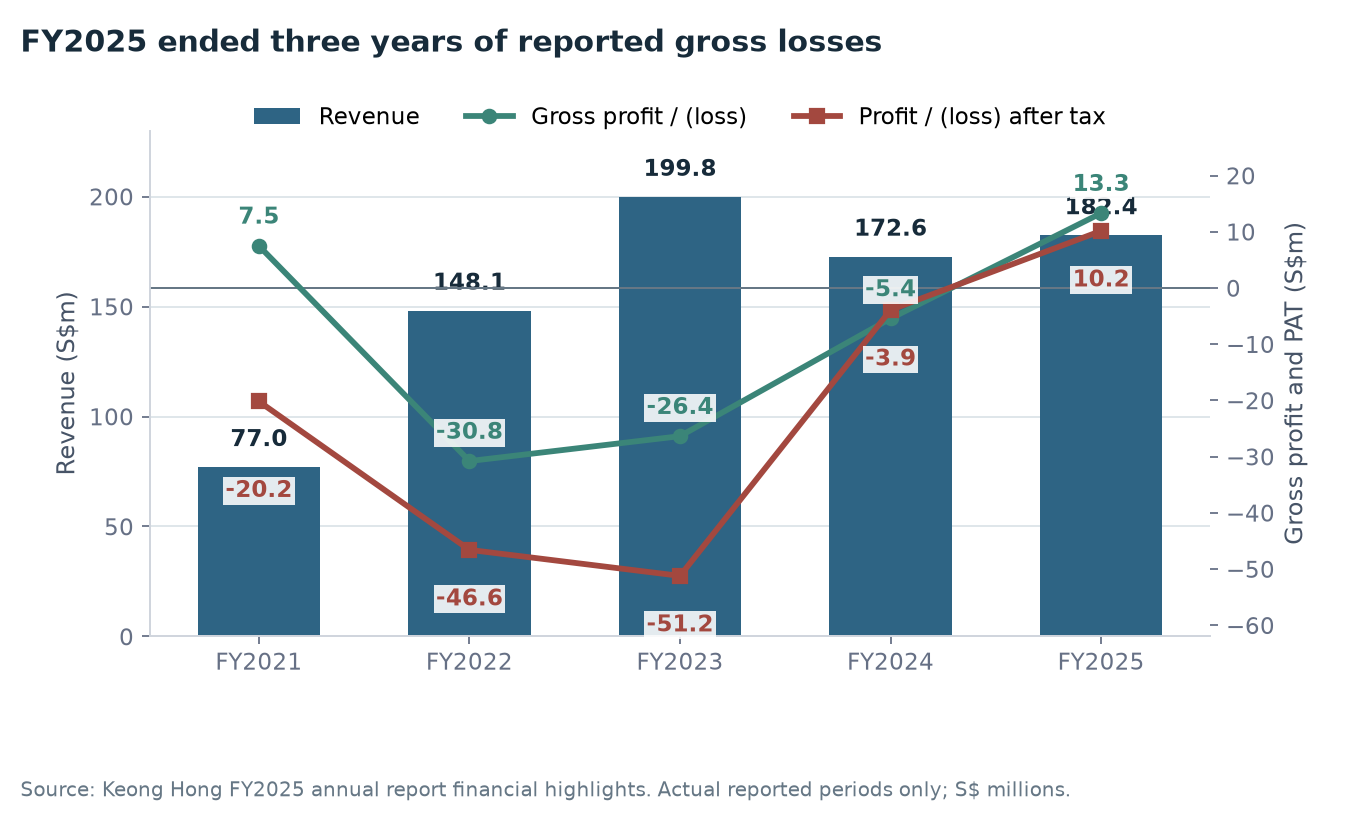
FY2025 ended a long reported loss sequence, but it did not erase the balance-sheet and cash consequences of that sequence. Revenue had more than doubled from FY2021 to FY2023, while gross losses widened and reported losses after tax accumulated. FY2024 narrowed both losses; FY2025 then restored a positive gross result and reported profit. The five filed years therefore describe a margin recovery after difficult project execution, not a smooth growth record.
Five-year as-filed earnings record — S$m
Measure
FY2021
FY2022
FY2023
FY2024
FY2025
Revenue
76.952
148.067
199.789
172.597
182.368
Gross profit / (loss)
7.488
(30.792)
(26.366)
(5.428)
13.307
Gross margin
9.7%
(20.8%)
(13.2%)
(3.1%)
7.3%
Profit / (loss) after tax
(20.180)
(46.591)
(51.216)
(3.916)
10.154
Basic EPS (cents)
(7.5)
(19.5)
(22.1)
(1.7)
4.3
NAV per share (cents)
67.5
47.2
21.8
21.5
25.6
FY2025 revenue increased 5.7% to S$182.368m. The larger change was below revenue: cost of sales fell to S$169.061m from S$178.025m, moving the group from a S$5.428m gross loss to S$13.307m gross profit. Management attributed that result to the near-completion of pre-pandemic projects that had carried higher construction costs, together with better productivity and project management. This matters because the improvement was tied partly to the project cohort rolling off, not just to more revenue.
Other income increased to S$13.135m from S$8.739m, helped by foreign-exchange gains, scrap sales and rental income. Administrative expenses fell to S$9.799m from S$18.310m. Finance costs declined to S$1.590m from S$2.138m as borrowings fell. The group still recorded S$9.897m of share of associate losses, only modestly lower than S$10.642m in FY2024. The S$10.154m reported profit therefore combined a construction gross-profit recovery with other income and lower costs while the associate drag remained material.
FY2025 was the first positive gross result in four years and the first reported profit in the five-year series. Source: FY2025 annual report financial highlights; actual reported periods only.
The nine-month contraction and the third-quarter turn
The nine months to June 2026 were much weaker than the same period a year earlier. Revenue fell 56.3% to S$68.548m, gross profit fell to S$2.278m from S$12.115m and gross margin compressed to 3.3% from 7.7%. Other income fell to S$3.808m from S$9.338m. Associate losses improved to S$1.400m from S$7.279m, but the group still moved from S$5.718m profit to a S$1.375m loss after tax.
Current-period operating record — S$m unless stated
Measure
3QFY2025
3QFY2026
Change
9MFY2025
9MFY2026
Change
Revenue
33.928
23.737
(30.0%)
156.782
68.548
(56.3%)
Gross profit
4.108
2.964
(27.8%)
12.115
2.278
(81.2%)
Gross margin
12.1%
12.5%
+0.4ppt
7.7%
3.3%
(4.4ppt)
Other income
3.897
1.648
(57.7%)
9.338
3.808
(59.2%)
Administrative expenses
(6.119)
(1.813)
(70.4%)
(7.961)
(5.682)
(28.6%)
Share of associate results
(3.409)
(1.473)
loss narrowed
(7.279)
(1.400)
loss narrowed
Profit / (loss) after tax
(1.761)
1.259
turned positive
5.718
(1.375)
turned negative
Basic EPS (cents)
(0.75)
0.54
turned positive
2.43
(0.59)
turned negative
The third quarter by itself was profitable: S$23.737m of revenue produced S$2.964m gross profit, a 12.5% margin, and S$1.259m profit after tax. That quarterly gross margin was slightly above 3QFY2025 despite lower revenue. It is useful evidence that at least one quarter recovered margin, but it does not reverse the nine-month revenue decline, working-capital outflow or full-period loss.
Order book, delivery schedule and customer concentration
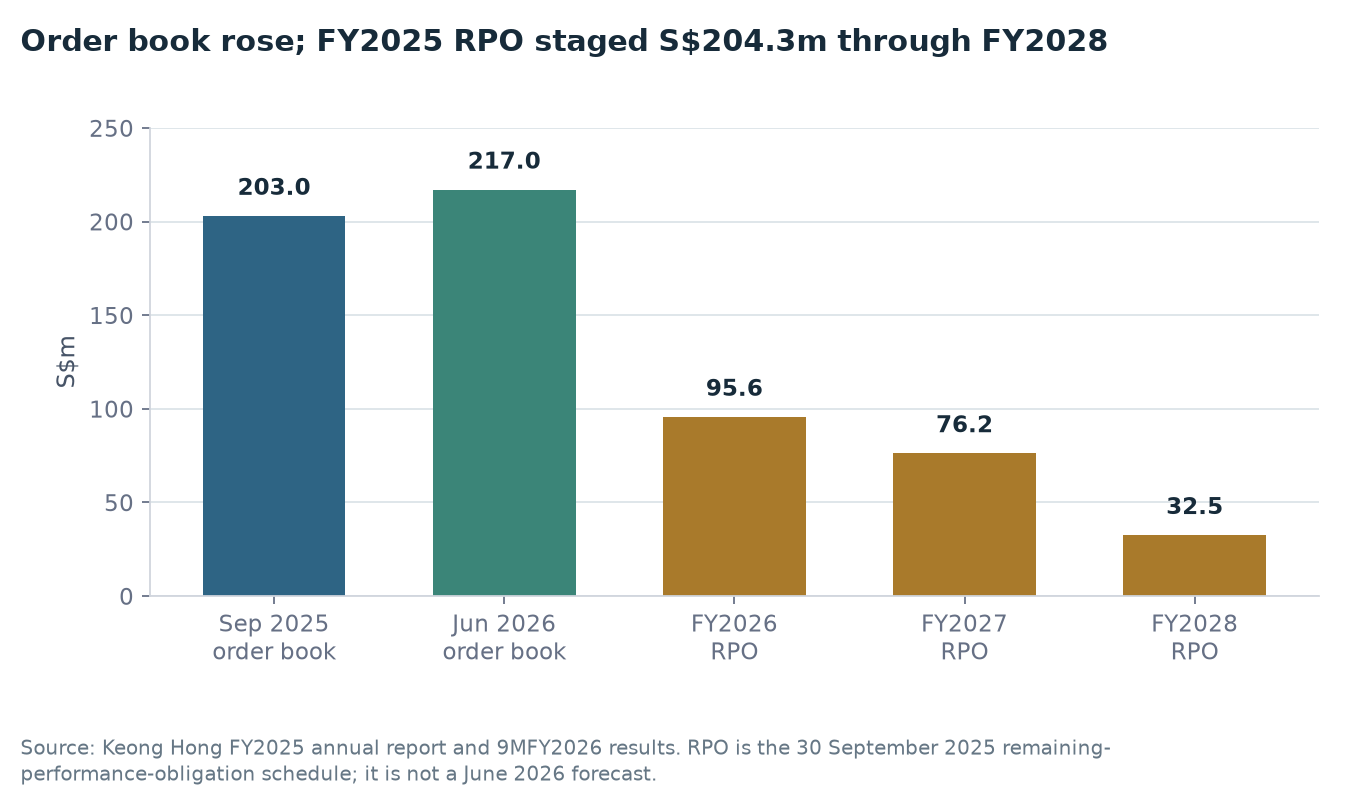
The disclosed construction order book was approximately S$203m at 30 September 2025 and approximately S$217m at 30 June 2026. The June project list included the mixed-commercial Solitaire on Cecil, the Tengah Plantation C5 build-to-order project and Serra Residences, a 133-unit freehold condominium at Bassein Road. The FY2025 year-end book was split 49.8% residential and 50.2% commercial.
The FY2025 financial-statement note gives a more precise accounting schedule. S$204.325m of transaction price was allocated to unsatisfied or partly satisfied performance obligations at 30 September 2025: S$95.638m assigned to FY2026, S$76.194m to FY2027 and S$32.493m to FY2028. The comparable total a year earlier was S$380.561m. The note excludes short contracts covered by the practical expedient, right-to-invoice work and constrained variable consideration, so the remaining-performance-obligation measure need not equal the rounded management order book.
30 September 2025 remaining performance obligations — S$m
Expected recognition period
Amount
Share of disclosed total
FY2026
95.638
46.8%
FY2027
76.194
37.3%
FY2028
32.493
15.9%
Total
204.325
100.0%
The June order book had risen, while the audited FY2025 note showed how the prior year-end obligation was staged. These are related but differently defined measures. Sources: FY2025 annual report and 9MFY2026 results.
Revenue concentration is a second part of the construction risk. Three customers accounted for S$152.389m, or 83% of FY2025 revenue, compared with 79% in FY2024. The largest represented 40% of revenue; the next two represented 23% and 20%. Concentration can help explain why project timing moves group revenue sharply, but the customer labels are anonymised and the filing does not map each customer to a named project.
Major-customer concentration — FY2025
Customer label in filing
Revenue (S$m)
Share of group revenue
Customer A
73.866
40%
Customer B
41.827
23%
Customer C
36.696
20%
Top three
152.389
83%
The order book is therefore an activity indicator, not a margin or cash schedule. Revenue depends on measured progress; gross profit depends on estimates of total contract cost, variations and liquidated-damages exposure; cash depends on certification, billing and collection. Those three clocks can move differently within the same project.
24 August 2026 MOUKeong Hong and Shaanxi Construction Engineering Group announced a five-year strategic-cooperation MOU describing up to S$3bn of indicative opportunities. The release expressly says this is not secured projects, order book or a forecast; it therefore does not change the disclosed order-book or revenue schedule. Original release.
Cash conversion and the working-capital bridge
FY2025 reported S$10.154m profit after tax but S$0.495m of operating cash outflow. In 9MFY2026, the group began with just S$0.580m of operating cash before working-capital changes. A S$5.570m release of contract assets was more than offset by receivables, contract liabilities and especially trade and other payables. The resulting operating cash outflow was S$7.646m.
9MFY2026 operating-cash bridge — S$m
Filed cash-flow line
Cash effect
Operating cash before working-capital changes
0.580
Trade and other receivables
(1.698)
Prepayments
(0.121)
Contract assets
5.570
Contract liabilities
(4.384)
Trade and other payables
(7.593)
Net cash used in operating activities
(7.646)
Investing activities generated S$14.052m, mainly including S$13.000m of proceeds from the KHPL disposal and interest received. Financing used S$11.010m, including S$9.514m of bank-debt repayment, S$1.119m of interest paid and S$0.377m of lease repayment. The three sections reconciled to a S$4.604m decline in cash equivalents, from S$26.751m at September 2025 to S$22.135m after pledged deposits at June 2026.
The balance sheet shows the same compression from a different angle. Current assets declined S$14.452m while current liabilities declined S$21.597m. Contract assets fell as work was billed, but trade and other payables also fell with lower activity. This improved the reported current-liability position while consuming operating cash.
Balance-sheet movement — S$m
Measure
30 Sep 2025
30 Jun 2026
Movement
Trade and other receivables
64.158
59.729
(4.429)
Contract assets
33.167
27.639
(5.528)
Cash and fixed deposits
32.851
28.235
(4.616)
Total current assets
130.317
115.865
(14.452)
Contract liabilities
16.195
11.811
(4.384)
Trade and other payables
61.446
53.800
(7.646)
Current bank borrowings
9.729
0.899
(8.830)
Total current liabilities
92.537
70.940
(21.597)
Total equity
60.228
59.146
(1.082)
Cash, debt and contingent credit exposure
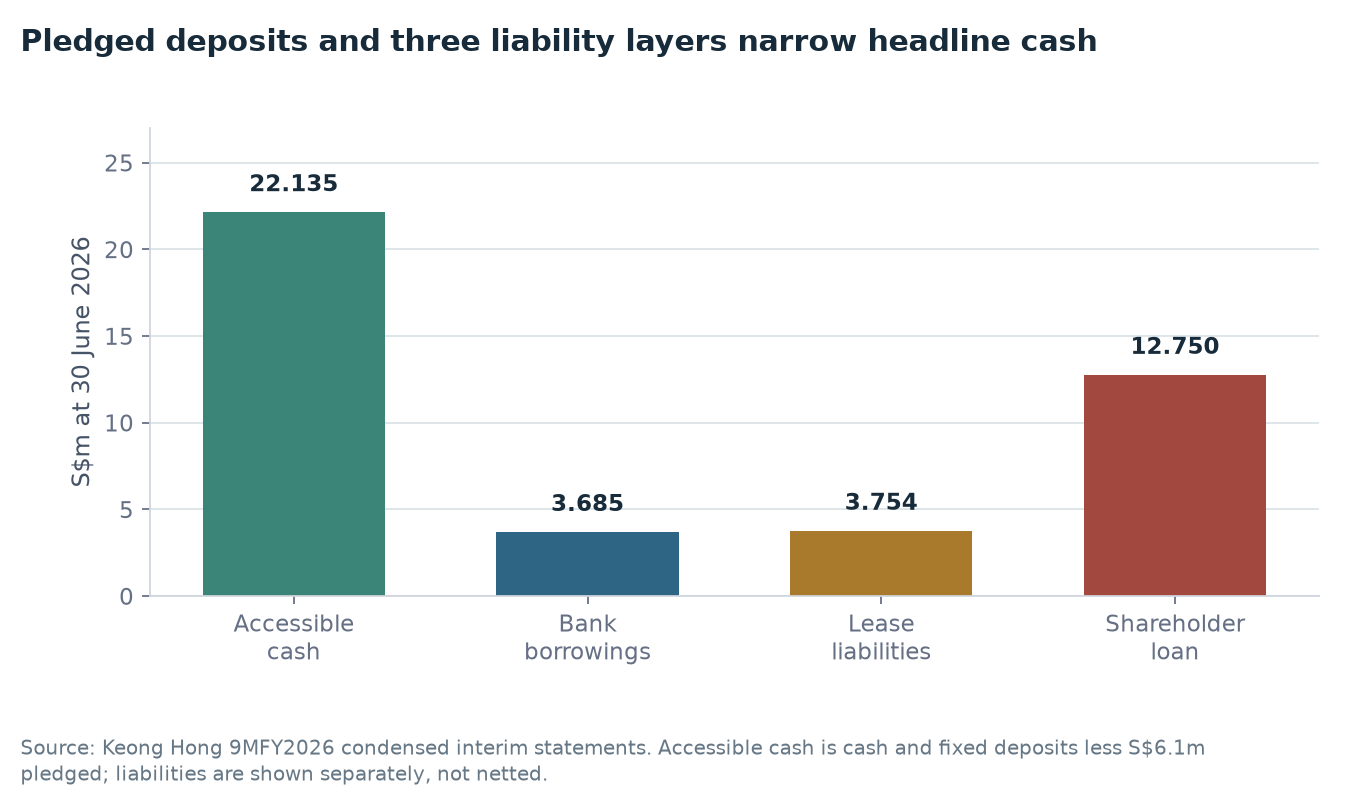
At 30 June 2026, cash and fixed deposits were S$28.235m. S$6.100m of fixed deposits was pledged, leaving S$22.135m of accessible cash on the disclosed basis. Bank borrowings were S$3.685m, down from S$13.199m at September 2025. Lease liabilities were S$3.754m and the shareholder loan was S$12.750m. The transparent bridge therefore gives S$1.946m of accessible economic net cash before any minimum operating-cash reserve.
30 June 2026 liquidity bridge — S$m
Cash and fixed deposits
28.235
Less: pledged fixed deposits
(6.100)
Accessible cash
22.135
Less: bank borrowings
(3.685)
Less: lease liabilities
(3.754)
Less: shareholder loan
(12.750)
Accessible economic net cash
1.946
Headline cash is narrowed first by pledged deposits and then by three separately disclosed liability layers. Source: 9MFY2026 condensed interim statements.
The S$12.750m shareholder loan was unsecured, had no fixed repayment date and was repayable only when subsidiary cash flows permit. Its rate was cut from 6.5% to 3.0% with effect from 1 April 2026. It is therefore different from scheduled bank debt, but it is still a claim ahead of common equity and belongs inside the economic liquidity perimeter.
At September 2025, the group had S$8.4m of undrawn banking and credit facilities for which conditions precedent had been met, down from S$13.5m a year earlier. The main bank facilities were secured by property, construction-contract receivables and company guarantees. By June 2026, S$2.786m was non-current and S$0.899m was current.
FY2025 guarantee measures — S$m
Measure
30 Sep 2025
What it represents
Corporate guarantees issued
74.353
Facilities of certain subsidiaries and an associate
Maximum amount that could be forced into settlement
65.984
Full claimed exposure identified by the annual report
Recognised corporate-guarantee liability
0.228
Accounting liability carried in payables
Earliest possible call period
within one year
Contractual timing, not a prediction of a call
These guarantee measures are not interchangeable. S$74.353m is the nominal guarantee set, S$65.984m is the stated maximum settlement amount and S$0.228m is the recognised liability. Treating only the booked liability as the exposure would omit the contingent perimeter; treating the full nominal amount as current debt would overstate the filed position.
Credit evidence gap. FY2025 disclosures said financial covenants were complied with, but the thresholds and headroom were not published. Facility utilisation also has to be read together with guarantees and performance obligations. No public issuer or instrument letter grade is assigned here.
The KHPL disposal did not immediately end the audit qualification
The FY2025 auditor issued a qualified opinion because it could not obtain sufficient appropriate evidence over Katong Holdings Pte Ltd, or KHPL. In FY2024 the investment had been reclassified from associate to non-current asset held for sale at S$34.117m after S$2.299m of share of losses. The evidence gap covered the associate classification, the historical results, the carrying amount and consequently the disposal result.
KHPL accounting and cash sequence — S$m
Date / period
Filed event
Amount
FY2024
Carrying amount reclassified as held for sale
34.117
FY2024
Share of KHPL losses recorded before reclassification
(2.299)
30 Jun 2025
Disposal consideration
34.500
FY2025
Reported disposal gain over carrying amount
0.383
FY2025
Cash proceeds received
15.000
9MFY2026
Further cash proceeds received
13.000
After Jun 2026
Remaining instalment in the sale schedule
6.500
The sale completed on 30 June 2025 for S$34.500m, and the group recorded a S$0.383m gain over the S$34.117m carrying amount. But the auditor could not verify the starting carrying amount, so it could not determine whether that gain was appropriately stated. The issuer described the FY2025 qualification as technical in nature and said the disposal addressed the earlier equity-accounting issue; the auditor's signed report nevertheless retained the qualification over the affected FY2025 result.
The cash sequence is more observable than the accounting gain. S$15.000m was received in FY2025, S$13.000m was recorded in 9MFY2026 and a S$6.500m instalment completed the stated S$34.500m consideration schedule. That makes disposal cash a separate fact from whether the historical carrying amount and reported gain were audit-supported.
PIIPL: a large non-cash reclassification inside a non-controlled perimeter
Pristine Islands Investment Pte Ltd, or PIIPL, holds the Maldives hotel and airport exposure and remained a 49%-owned associate. Keong Hong and the other shareholder agreed to capitalise shareholder loans pro rata in FY2025. PIIPL issued new shares for USD109.876m; Keong Hong received 53.839m shares and reclassified S$69.523m from amounts due from associate to unquoted equity cost. The annual report expressly identifies this as non-cash.
PIIPL-related accounting markers at 30 September 2025
Marker
Amount
Reading boundary
Keong Hong ownership
about 49%
Associate; not consolidated
Shareholder-loan amount reclassified into equity cost
S$69.523m
Gross non-cash reclassification, not new funding
PIIPL investment carrying amount
S$15.968m
Net equity-accounted balance in the associate note
Amount due from PIIPL disclosed in receivables note
S$20.493m
Interest-bearing at 8%; kept separate here
The S$69.523m reclassification and S$15.968m carrying amount are not additive exposure measures: one is a gross amount moved into equity cost, while the other is the resulting net equity-accounted carrying balance after reserves, losses and eliminations. The receivables note separately identifies S$20.493m due from PIIPL at an 8% rate. Because the notes use different accounting layers, this page preserves each marker rather than manufacturing one aggregate.
Operating evidence remained mixed. Combined occupancy at the two Maldives hotels was 49.6% in FY2025 against a 58.3% industry average. From January to June 2026 it improved to 51.9%, while the cited industry average was 55.7%. The gap narrowed from 8.7 percentage points to 3.8 points, but occupancy alone does not establish hotel cash generation, airport debt service or distributions to the listed group.
Maldives hotel occupancy evidence
Period
Two Keong Hong-associated hotels
Industry comparator
Gap
FY2025
49.6%
58.3%
(8.7ppt)
Jan–Jun 2026
51.9%
55.7%
(3.8ppt)
Equity-accounted value is not accessible parent cash. Upstream cash still depends on PIIPL's own operating cash, debt service, board decisions and any dividend or loan-repayment action. That distinction is why the investor snapshot treats the associate as a separate cash perimeter rather than as part of headline group cash.
Ownership, governance and capital allocation
At 30 June 2026 the company had 235.010m issued shares excluding treasury shares, unchanged from September 2025. Group equity was S$59.146m, equivalent to about 25.2 Singapore cents per issued share on the filed share count. That is an accounting reference point only; it includes associate carrying balances and does not make the underlying assets available as parent cash.
The public evidence establishes a founder-influenced listed group, treasury shares, project and associate investment exposure, and a S$12.750m ultimate-shareholder loan. The shareholder loan's reduced interest rate eased the running cost from April 2026, while its no-fixed-term structure left repayment dependent on subsidiary cash flows.
Capital allocation has included construction working capital, property development and a material Maldives associate commitment. The KHPL disposal recycled S$34.500m of stated consideration over instalments; the PIIPL reclassification converted a S$69.523m loan balance into equity without cash arriving at Keong Hong. Those two events look similar in an investment note but have opposite cash direction: one monetised an asset, the other moved an existing claim deeper into associate equity.
The audit qualification and non-controlled associate perimeter mean carrying amount, economic exposure and cash available to the listed parent must remain separate. The open governance test is therefore not just whether an asset is recorded, but whether its cash can be observed upstreaming and whether the next audit can support the affected balances.
Price record and key developments
Trading is sparse. The public secondary series reviewed showed a 22.6% move on 12 May 2026, a 17.6% move in the opposite direction on 25 May 2026, and little or no volume on many intervening sessions. The full 24–36 month adjusted-close series and same-session peer control were not available in a form that could be independently frozen for this run, so no causal attribution is made and the price-history domain remains partially blocked.
Selected 2026 trading sessions from the public historical series
Session
Close (S$)
Session change
Volume
Disposition
12 May 2026
0.163
+22.6%
64,200
No announced cause established
25 May 2026
0.136
−17.6%
127,400
No announced cause established
5 June 2026
0.132
−2.2%
100
Very low-volume print
The principal filed developments in the current evidence window were the FY2025 annual report on 16 March 2026, the half-year result on 14 May 2026 and the 9MFY2026 result on 13 August 2026. These dates are recorded as information events; they are not presented as causes of the selected price moves without a complete timestamped market-control study.
What you can watch yourself
Every other test on this page waits for the company to file. These do not. Each row is a series you can look up yourself, free, today — with the level this reading was built against, the levels that would put it in question, and what the series cannot tell you.
BCA's January construction-prospects release; read total construction demand, and the August review that revises it. Building and Construction Authority, Singapore
Last recorded
50 S$bn, 2026-01-22
What the reading assumes
50.5 S$bn (BCA reported actual, 2025)
Watch / alert
47 and 39 S$bn, on a move below — currently between the assumed level and the watch level
How often to look
twice yearly, at the January forecast and the August review (the series prints event)
What it points to. The national value of contracts awarded is the addressable tender pool from which Keong Hong replenishes its construction order book.
Direction only — this pack does not carry a coefficient from this series to reported earnings.
What it cannot tell you. BCA reports the national public-and-private award pool, not Keong Hong's tender set. The series cannot identify which contracts Keong Hong wins, bid discipline, project timing or margin, and the existing order book can insulate near-term revenue from a change in the current award cycle.
Settled by the next results, order-book and new-award disclosures, due 2027-02-28. Lead time: award to output runs into following years; BCA states the lag but does not quantify it.
Watchlist reviewed on 2026-08-27; each observation has its own date above. This watchlist date does not change the company research cutoff. A series moving past a level is a reason to re-read the case, not a recommendation. The same series across every company covered: what you can watch.
Notes and sources
Questions the filings leave open
Project economics. What portion of the S$217m order book is executable, what gross margin and cash schedule does management expect, and how much remaining defects or rectification cost is embedded?
Audit evidence. What changed after the FY2025 qualification, and what evidence would allow the FY2026 auditor to issue an unmodified opinion?
Facilities and guarantees. What are the covenant definitions, thresholds, test dates, headroom and performance-bond facility utilisation?
Associate cash. What are PIIPL's debt service, distributable cash and expected dividends or shareholder-loan repayments to Keong Hong?
Download
A print-ready PDF of this page, for reading away from the screen: Keong Hong Holdings evidence library (PDF). It carries the same content as this page — the reported record, the nine-month contraction and third-quarter turn, the order book and customer concentration, cash conversion, cash, debt and contingent credit exposure, the KHPL disposal and audit qualification, the PIIPL reclassification, ownership and governance, the price record and open questions — and the same omissions: no rating, no fair value, no forecast.
Principal primary evidence: Keong Hong's FY2025 annual report and 9MFY2026 condensed interim financial statements. The source library also retains prior annual reports, results and announcements. The listed-parent SGX tape was swept through 28 August 2026; no issuer announcement after 13 August 2026 was located. The separate PIIPL disclosure stream is incomplete and blocks a group-wide completeness claim.
Keong Hong Holdings Limited, FY2025 Annual Report, filed 16 March 2026.
Keong Hong Holdings Limited, unaudited condensed interim financial statements for 9MFY2026, filed 13 August 2026.
Building and Construction Authority, Singapore construction demand outlook for 2026, published 22 January 2026.
Corrections are made in place with the page's modified date advanced. Questions about a number or source can be submitted below; no rating, valuation or recommendation is published on this page.
Reader questions & corrections
Ask about this company, challenge a source or suggest a factual correction. Only selected questions that SMID Research has reviewed and answered are published.
Submissions are private by default. Your email is encrypted and never published. Please do not send confidential or inside information, allegations about individuals, promotions, or requests for personalised investment advice.
Behind the lock. A private working view exists at /vault/5tt/ 🔒. Its direction and any scenario values are not stated on this public page.
Important. This page is a general-circulation record of publicly filed information about Keong Hong Holdings Limited. It is not investment advice, not a recommendation, and not an offer or solicitation to buy or sell any security. It does not take account of the objectives, financial situation or needs of any person. No rating, valuation, target price or expected return is expressed or implied. Figures are as filed by the issuer or computed from filed figures with the computation shown; they may contain errors and are not warranted. Readers should consult a licensed adviser and the issuer's own filings before making any decision.
These bounded retrospective corrections clarify specific published facts or calculations. They retain each report's existing research cutoff and do not represent a full refresh or a finding that all possible issues are resolved.
Keong Hong Holdings
Verified Fact. The 24 August 2026 Shaanxi cooperation MOU describes up to S$3bn of indicative opportunities over five years; KHPL is Katong Holdings Pte Ltd. Sources: Source; Source. Limitation: The MOU is not secured projects, order book or a forecast; the legal-name correction does not extend the audit qualification.
Transcripts
Find available event transcripts in the transcript library.